
Mycochemical Profiling of Hypsizygus ulmarius (Bull. Ex Fr.) Redhead Fruit Bodies Cultivated on Local Nigerian Lignocellulosic Substrates
-
Magnus C. Nwoko

Department of Biology, Federal University of Technology, Owerri, Nigeria
Stella N. NmeziDepartment of Biology, Federal University of Technology, Owerri, Nigeria
Chileobi C. ObichiDepartment of Biology, Federal University of Technology, Owerri, Nigeria
Maryjane C. NwigweDepartment of Biology, Federal University of Technology, Owerri, Nigeria
Amarachi G. NwaoguDepartment of Biology, Alvan Ikoku Federal University of Education, Owerri, Nigeria
Uchenna R. OnyeizuDepartment of Environmental Management and Toxicology, Michael Okpara University of Agriculture, Umudike, Nigeria
Felix C. AkannoDepartment of Statistics, Federal University of Technology, Owerri, Nigeria
Jane C. OkoroDepartment of Biology, Federal University of Technology, Owerri, Nigeria
K.U. UkpaiDepartment of Plant Health Management, Michael Okpara University of Agriculture, Umudike, Nigeria
C.S. OkereDepartment of Plant Health Management, Michael Okpara University of Agriculture, Umudike, Nigeria
Chinweokwu R. EhumaduDepartment of Plant Science and Biotechnology, Michael Okpara University of Agriculture, Umudike, Nigeria
U.F. MaduegbunamRaw Materials Research and Development Council, Abuja, Nigeria
Maximus M. EbulueDepartment of Biotechnology, Federal University of Technology, Owerri, Nigeria
Vincent O. IgbojionuAbia State College of Health Sciences and Management Technology, Aba, Nigeria
| Received 15 May, 2026 |
Accepted 28 Aug, 2026 |
Published 29 Aug, 2026 |
Background and Objective: The demand for organic raw materials has increased significantly in the development of natural products, particularly following the COVID-19 pandemic, which intensified interest in the pharmaceutical, beverage, and cosmetic industries. This study aimed to profile aromatic myco-chemical compounds in Hypsizygus ulmarius sporophores cultivated on locally available Nigerian substrates. Materials and Methods: Mycelium of Hypsizygus ulmarius was cultured and maintained on Potato Dextrose Agar (PDA) and sorghum grain spawn, then inoculated onto sugarcane bagasse (SB), Panicum maximum (PM) straw, and their combination (SB+PM; 1:1). Aromatic compounds were extracted using cold and hot extraction techniques and analyzed via Gas Chromatography-Mass Spectrometry (GC-MS). Proximate composition and heavy metals were determined using Association of Official Analytical Chemists methods and Energy Dispersive X-ray Fluorescence (EDXRF), respectively. All experimental data were analyzed using Analysis of Variance (ANOVA) of the SPSS v25, and post hoc by Duncan’s Multiple Range Test (DMRT) at p<0.05 while results were presented as mean±SD. Results: Sporophores cultivated on SB exhibited the largest cap size (7.14±0.84 cm) and weight (7.11±1.94 g), while those grown on PM had the longest stipe. Hot extraction yielded more volatile compounds than cold extraction. Octadecanoic acid methyl ester and Azulene were the most abundant compounds detected under cold and hot extraction methods, respectively. Heavy metals (Cr, Cd, Pb) were below permissible limits, whereas essential elements such as Fe and Zn showed significant variation (p≤0.05). Conclusion: The findings highlight the potential of H. ulmarius as a valuable source of aromatic and nutritionally relevant compounds. Its commercial cultivation on local substrates could enhance the mushroom value chain and contribute to employment generation among Nigerian youth.
| Copyright © 2026 Nwoko et al. This is an open-access article distributed under the Creative Commons Attribution License, which permits unrestricted use, distribution, and reproduction in any medium, provided the original work is properly cited. |
INTRODUCTION
Molecular compounds in mushrooms occur as flavours, aromas and fragrances which are essential in the food, cosmetic and pharmaceutical industries. Flavours are volatile compounds in food stuff, whose aromatic properties are detected by smelling. They may be naturally present or synthesized during their processing by chemical reactions or microbial action. These compounds are usually present in very low concentrations1,2.
Mushrooms have traditionally been relished as food or food flavouring agents because of their unique and subtle aroma1. The main odorants of mushroom aroma are eight-carbon compounds (C8). The 1-octen-3-ol is a characteristic aromatic compound of mushrooms; the profile of these essential aromatic molecular compounds varies with species and culture condition such as substrates. Cultivation conditions may also affect other mushroom properties, especially productivity, edibility and nutritional composition3,4.
Mushroom flavours are mostly the unsaturated ketones, which contribute significantly to its characteristic aroma, largely responsible for their culinary umami taste appeal2. The main aromatic compounds in mushrooms have been investigated and identified mostly as the C8 group, which are mostly volatile organic compounds (VOCs), such as the 3-octanone, 3-octanol, 1-octen-3-ol, 2-octen1-ol and 1-octen-3-one. Among these aroma compounds, 1-octen-3-ol, also known as mushroom alcohol, is naturally found in all species of basidiomycetes and is considered to be the most important aroma compound for the culinary purposes1. This compound is present in most edible mushrooms in the amounts ranging from 1-4 mg/100 g of fresh fruit bodies and its bio-generation is due to oxygenation of the enzyme lipoxygenase in linoleic acid5. Lipoxygenase (LOX; linoleate: Oxygen oxidoreductase, EC 1.13.11.12) comprised a class of non-heme iron-containing dioxygenases, which is considered as a key enzyme in the oxidative degradation of lipid4. Apart from mushrooms, LOX is widely distributed in bacteria, algae, mammals and higher plants1. This enzyme acts on polyunsaturated fatty acid with cis,cis-1,4-pentadiene system, but geometrical configuration with cis-trans and trans-trans, which render it inactive or act as inhibitors to lipoxygenase catalysis2. Abdullah et al.6 reported that the 13-hydroperoxy-9Z and 11-Ectadecadienoic acid [13-Z, E-HPOD] first result from the hydroperoxidation of linoleic acid by LOX, which is subsequently converted to 1-octen-3-one and 10-carbon compounds, and the former, finally reduced by alcohol oxidoreductase to 1-octen-3-ol7,8.
Another important compound obtainable from mushrooms is azulene. It is a nonalternant 10 π-electron nonbenzenoid aromatic hydrocarbon, which has a fused structure of five and seven-membered rings2. It is used as a moisturizer for the treatment and prevention of skin diseases and other blemishes such as scaly skin, itchy skin, diaper rash, skin burns7.
Similarly, mushrooms are considered a rich source of proteins, which make up 5% of the weight of a fresh fungus1. This amount is equivalent to 20-40% by weight of dry matter, with high contents of vitamins B and C complex8,9. Mushrooms are also rich in elements: Ca, P, Fe, K and low in Na, and is recommended for people with diabetes, high blood pressure and cardiac problems7. Chen et al.9 studied the proximate content of P. sajor-caju and revealed that using different agro-wastes such as: Soybean, paddy straw, wheat, sunflower and Pigeon pea stalks, Soybean straws showed the maximum protein (25.80%), fat 92.82%) and ash (7.30%) contents9. He also reported that the variation in these nutrients could be due to their quality and quantity in the substrates1.
Unlike other microbial sources of single cell proteins (SCPs), mushrooms have high consumer preference due to their unique taste2. They possess nutritional and medicinal properties, often referred to as neutraceuticals10. Mushrooms are considered to be good source of digestible proteins (10-40%), carbohydrates (3-21%) and dietary fibre (3-35%) on dry weight basis9. Edible species are limiting in sulphur-containing amino acids like cysteine and methionine11. Essential minerals such as iron, copper, zinc and manganese, which play important role in biological systems, are naturally found in mushrooms2.
While fungi have long been utilized in the food industry, their potential for the industrial production of natural compounds has been overlooked. The general economic benefits of mushrooms should not be restricted to dietary, nutritional, pharmaceutical, or environmental, but could be extended to cosmetics or even pests and insects control. This study aimed to profile the aromatic molecular and mycochemical compounds of H. ulmarius fruit bodies cultivated on locally available Nigerian substrates.
MATERIALS AND METHODS
Study area and duration: The study was conducted at the Mushroom Research Laboratory of the Department of Biology, Federal University of Technology, Owerri (FUTO). The area is geographically located between Latitudes 5°396'N and 5°397'N and Longitudes 6°983'E and 6°987'E between April and September, 2025.
Spawn production/multiplication: Spawn of H. ulmarius was prepared using sorghum grains. The grains were subsequently boiled in tap water for 10-15 min using a gas-burning flame and completely drained of water before mixing with 2% (w/w) CaCo3 and 4% CaSO4 to optimize pH and prevent grain clumping, respectively; as recommended by Rudolph et al.2. They were further sterilized in an autoclave at 121°C for 30 min and allowed to cool at room temperature before they were aseptically inoculated with actively growing mother mycelial culture of H. ulmarius, by grain-to-grain transfer; and were subsequently incubated in the dark (0.25-180 Lux) at 272°C ) until grains were fully colonized by H. ulmarius mycelia12. The completely colonized grain (spawn) was used to inoculate the sugarcane bagasse or final substrate during fruit body production2-5.
Morphological measurements
Measurement of fruit body morphology: The effect of substrate on Pileus and stipe sizes of fruit bodies was determined at maturity. The mushrooms were harvested accordingly while Pileus and stipe sizes were measured in cm using meter rule13.
Cap diameter: This was obtained by placing a transparent ruler across the centre of the pileus and reading off the diameter13.
Cold extraction of molecular compounds: Chilled mushrooms (10 g) were macerated in a prechilled mortar and pestle (kept in ice bath) by using 10 mL of chilled water12. Pentadecane (SD fine chemicals, Mumbai) at a concentration of 5000 kg per 100 g to this paste and filled in a stoppered glass bottle. Chilled diethyl ether (10 mL) was added to it. The stoppered bottle was shaken to mix well all the contents and kept in a refrigerator (5°C) for 2 hrs. The contents were extracted with 10 mL of diethyl ether for another 2 times followed by 2 hrs of cold storage each time. After this, all the solvent was pooled and concentrated to 2 mL at room temperature9. This was analyzed for the presence of flavour components using Gas Chromatography and a Mass Spectrometer (GC-MS).
Hot extraction of molecular compounds: The extract for analysis of volatiles was prepared by using the method of Zawirska-Wojtasiak14. Ten grams of mushroom sample was macerated by using a porcelain mortar and pestle in 100 mL distilled water and pentadecane at the concentration of 500 μg per 100 g of mushroom was added to it as an inner standard. This was allowed to stand for15-20 min for enzyme activation and then steam distilled at 50°C for 2 hrs and condensed fraction was collected into a well stoppered flask. This condensate (about 50 mL) was extracted 3 times with equal concentration of dichloromethane and the pooled solvent was dried over anhydrous Na2SO4 It was further concentrated to 2 mL at room temperature and analyzed for flavour components by using GC-MS analytical protocol12,14.
Proximate analysis: Proximate analysis was conducted on each of the 3 fruit body samples. The protein, ash, fat, dry matter and crude fibres were determined according to the modified method by Stihi et al.15 while Carbohydrate contents were determined by difference i.e:
Determination of heavy metals: The amount of Fe, Cu, and Zn in the sample was estimated by Energy Dispersive X-ray Fluorescence (EDXRF) technique according to the method of Stihi et al.15. Cadmium (Cd) and Lead (Pb) were determined by the method of the calibration curve according to the absorption concentration. Several standard solutions of different known concentrations were prepared and the elemental concentration in the unknown sample was determined by extrapolation from the calibration curve. All fruit body sample concentrations were reported as mg/kg dry weight of material.
Statistical analysis: All experimental data were analyzed using Analysis of Variance (ANOVA) with SPSS version 25. Treatment means were separated using Duncan’s Multiple Range Test (DMRT) at a 95% confidence level (p<0.05). Results were expressed as mean±standard deviation.
RESULTS AND DISCUSSION
Results of morphological features in Table 1 showed that fruit bodies from SB had the largest cap (7.14±0.84 cm) and WT (7.11±1.94 g) while those cultured on PM had the longest stipe compared to SB and SB+PM, as shown in Table 1. These mean values generally represent considerably large fruit body sizes. It has been generally noted that substrate and genetic characteristics are the two main factors that determine the morphological features of mushrooms16,17. Stihi et al.15 reported that cap diameter and stipe length of fruiting bodies of mushrooms are dependent on the amount of oxygen circulation at the onset of primordial initiation and fruit body development16. Therefore, the large sizes of fruiting bodies observed in this study could be due to ample supply of oxygen in the cropping room during fruitbody development. These results significantly relate to those published by Ekanayake et al.13 in an experiment involving the use of local substrates for the production of oyster mushrooms.
Azulene is a very important organic compound and an isomer of naphthalene widely used as a moisturizer to treat or prevent dry rough, scaly, itchy skin and other minor skin irritations12.
| Table 1: | Macroscopic characteristics of H. ulmarius | |||
| Substrate | SB | PM | SB+PM |
| CD cm | 7.14±0.84a | 5.10±0.57b | 4.90±0.23a |
| SL cm | 2.78±0.16a | 3.14±0.36a | 2.89±0.10a |
| WT g | 7.11±1.94a | 3.91±0.74b | 3.09±0.38a |
| Means followed by the same alphabet within column are not significantly different by DMRT (p≥0.05), means±SEM (n = 3), SB: Sugarcane bagasse, PM: Panicum maximum, CD: Cap diameter, SL: Stipe length and WT: Weight | |||
| Table 2: | Nutritional Information of H. ulmarius | |||
| Substrate nutritional info. | SB | PM | SB+PM |
| MC | 10.29±0.01g | 10.13±0.03f | 10.19±0.08f |
| DM | 89.72±0.00f | 89.87±0.03e | 89.81±0.08e |
| ASH | 2.18±0.02e | 2.44±0.02c | 2.51±0.06d |
| CP | 22.07±0.53d | 17.61±0.23b | 19.61±0.09c |
| EE | 2.14±0.02c | 2.31±0.11b | 2.16±0.05c |
| CF | 3.64±2.99b | 0.79±0.06b | 0.77±.040b |
| CHO | 30.03±2.47a | 23.14±0.42a | 25.04±0.13a |
| MC: Moisture content, DM: Dry matter, ASH: Ash, CP: Crude protein, EE: Ether extract, CF: Crude fiber, CHO: Carbohydrates, Values are expressed as g/100 g (%, dry-weight basis) and presented as mean±SE. Different superscript lowercase letters indicate significant differences (p<0.05) | |||
|
|
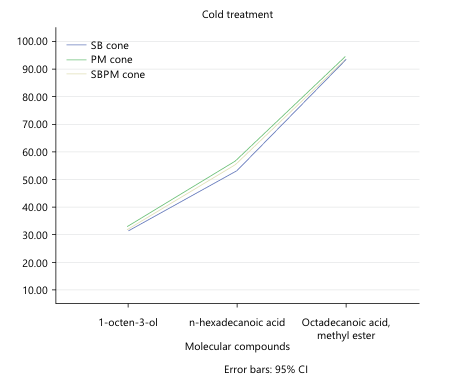
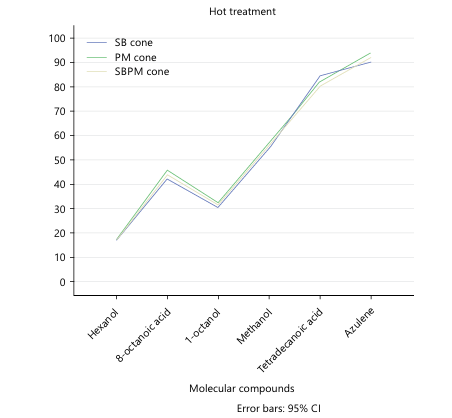
Aromatic compounds are the most important organoleptic characteristic of mushroom products15. Misharina et al.12 stated that the principal compounds producing the aroma of mushrooms are aliphatic alcohols and ketones and the qualitative and quantitative compositions of volatile substances significantly depend on extraction method and substrate.
|
Results of proximate analysis of H. ulmarius (Table 2) show that crude protein content of fruitbodies cultivated on SB (22.07±0.53) was higher than those of PM and SB+PM. Mushroom protein has been identified as a valuable additive to the human diet16. Similarly, the results of the proximate content of Pleurotus sajor-caju revealed that using different agro-wastes such as Soybean, paddy straw, wheat or dowar straws, sunflower and Pigeon pea stalks showed maximum protein (25.80%), fat 92.82%) and ash (7.30%) content.
Carbohydrate (CHO) was the second highest nutrient in fruitbodies across all the substrates after dry mater. Ether extract content recorded in fruitbodies from all the substrate was low. This was in conformity with the reports by Stihi et al.15. Hausiku and Mupambwa20 reported that mushrooms generally contain low-oil and fat, and because of the low content of oil and fat in mushrooms, they are recommended as good supplements for patients with cardiac problems.
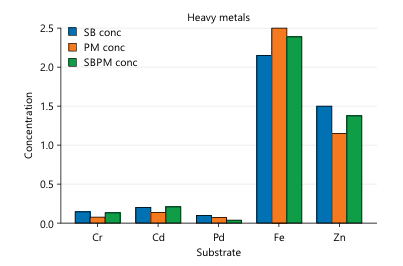
Results of heavy metals content (Fig. 3) of the mushrooms show that some heavy metals were detected in relatively low concentrations in the fruitbodies harvested from the three substrate21-25. Unlike Fe and Zn, results showed that Cr, Cd and Pb contents were not significantly different (p≥0.05) in fruitbodies cultivated on the three substrates. The recorded Pb and Cd values fall below the European Communities (Commission Regulation [EC] No 466/2001) admitted maximum level at 2 and 3 mg/1 kg d.w, respectively, in cultivated mushrooms. Different studies22,26-28 reported that mushrooms can uptake heavy metals from the substrate by means of mycelia or even from the atmosphere through their stipe and pileus tissues. The distribution of these heavy metals is usually uneven within the fruiting body29-32.
CONCLUSION
This study demonstrated that locally available lignocellulosic substrates significantly influenced the mycochemical composition and nutritional quality of Hypsizygus ulmarius fruit bodies. Hot extraction proved more effective than cold extraction for recovering volatile aromatic compounds, with Azulene predominating in hot extracts and Octadecanoic acid methyl ester in cold extracts. Mushrooms cultivated on sugarcane bagasse exhibited superior morphological characteristics and higher protein content, while all samples contained heavy metals within permissible safety limits. These findings indicate that H. ulmarius cultivated on indigenous substrates represents a safe and valuable source of nutritionally important and industrially relevant bioactive compounds, supporting its potential application in the food, pharmaceutical, and cosmetic industries. Further studies should evaluate the biological activities and commercial-scale production of the identified aromatic compounds.
SIGNIFICANCE STATEMENT
This study provides novel information on the influence of locally available Nigerian lignocellulosic substrates on the aromatic compound profile, nutritional composition, and heavy metal content of Hypsizygus ulmarius. The findings identify sugarcane bagasse as a promising substrate for producing mushrooms with enhanced nutritional and bioactive properties while maintaining food safety standards. These results contribute to the sustainable utilization of agricultural residues, support value addition in mushroom cultivation, and provide a scientific basis for the development of mushroom-based products for the food, pharmaceutical, and cosmetic industries.
ACKNOWLEDGMENTS
We appreciate the management of the collaborating institutions and agencies: The Federal University of Technology Owerri (FUTO), Nigeria, The Michael Okpara University of Agriculture, Umudike and The Raw Materials Research and Development Agency, Abuja-Nigeria, for providing both human and material resources that made this study possible.
REFERENCES
- Bernaś, E., G. Jaworska and W. Kmiecik, 2006. Storage and processing of edible mushrooms. Acta Sci. Polonorum Technologia Aliment., 5: 5-23.
- Rudolph, M., A. Schlereth, M. Körner, K. Feussner and E. Berndt et al., 2011. The lipoxygenase-dependent oxygenation of lipid body membranes is promoted by a patatin-type phospholipase in cucumber cotyledons. J. Exp. Bot., 62: 749-760.
- Okwulehie, I.C., C.P. Nwosu and O.C. Johnpaul, 2007. Pharmaceutical and nutritional prospects of two wild macro-fungi found in Nigeria. Biotechnology, 6: 567-572.
- Sanjel, P., R.K. Shrestha and J. Shrestha, 2021. Performance of oyster mushroom (Pleurotus ostreatus) grown on different fingermillet husk substrates. J. Agric. Nat. Res. 4: 291-300.
- Akakabe, Y., K. Matsui, T. Kajiwara, 2005. Stereochemical correlation between 10-hydroperoxyoctadecadienoic acid and 1-octen-3-ol in Lentinula edodes and Tricholoma matsutake mushrooms. Biosci., Biotechnol., Biochem., 69: 1539-1544.
- Abdullah, Q.L., M.H. Al-Jibori and S.B. Al-Arrji, 2014. Extraction, purification and characterization of lipoxygenase from Pleurotus ostreatus. Iraqi J. Sci., 55: 61-69.
- Shoji, T. and S. Ito, 2018. The Preparation and Properties of Heteroarylazulenes and Hetero-Fused Azulenes. In: Advances in Heterocyclic Chemistry, Scriven, E.F.V. and C.A. Ramsden (Eds.), Elsevier Amsterdam, Netherlands, ISBN: 978-0-12-815209-6, pp: 1-54.
- Furlani, R.P.Z. and H.T. Godoy, 2008. Vitamins B1 and B2 contents in cultivated mushrooms. Food Chem., 106: 816-819.
- Chen, Y., F.L. Sossah, Z. Lv, Y. Lv and L. Tian et al., 2021. Effect of wheat bran and maize straw substrates on the agronomic traits and nutritional content of Auricularia cornea cv. Yu Muer. Sci. Hortic., . 286.
- Schachter, E.N., E. Zuskin, S. Goswami, V. Castranova and U. Arumugam et al., 2005. Pharmacological study of oyster mushroom (Pleurotus ostreatus) extract on isolated guinea pig trachea smooth muscle. Lung, 183: 63-71.
- Mallavadhani, U.V., A.V.S. Sudharkar, K.V.S. Satyanarayana, A. Mahapatra, W. Li and R.B. van Breemen, 2006. Chemical and analytical screening of some edible mushrooms. Food Chem., 95: 58-64.
- Misharina, T.A., S.M. Muhutdinova, G.G. Zharikova, M.B. Terenina and N.I. Krikunova, 2009. The composition of atile components of cepe (Boletus edulis) and oyster mushrooms (Pleurotus ostreatus). Appl. Biochem. Microbiol., 45: 187-193.
- Ekanayake, S., C. Egodawatta, R.N. Attanayake and D. Perera, 2023. From salt pan to saucepan: Salicornia, a halophytic vegetable with an array of potential health benefits. Food Front., 4: 641-676.
- Zawirska-Wojtasiak, R., 2004. Optical purity of (R)-(−)-1-octen-3-ol in the aroma of various species of edible mushrooms. Food Chem., 86: 113-118.
- Stihi, C., C. Radulescu, G. Busuioc, I.V. Popescu, A. Gheboianu and A. Ene, 2011. Studies on accumulation of heavy metals from substrate to edible wild mushrooms. Rom J. Phys., 56: 257-264.
- Vaezi, M., 2023. Efficacy and biomedical roles of unsaturated fatty acids as bioactive food components. Curr. Chem. Biol., 17: 79-90.
- Kumar, S., G. Singh, R. Singh, P. Kumar and S.S. Bhatt, 2022. Assessment of grain extract media on mycelial growth of Pleurotus spp. (P. sapidus and P. flabellatus). Asian J. Environ. Ecol., 17: 10-16.
- Finimundy, T.C., L. Barros, R.C. Calhelha, M.J. Alves and M.A. Prieto et al., 2018. Multifunctions of Pleurotus sajor-caju (Fr.) Singer: A highly nutritious food and a source for bioactive compounds. Food Chem., 245: 150-158.
- Kaaya, G.P., P.N. Kadhila-Muandingi, H.R. Lotfy and K.E. Mshigeni, 2012. Determination of optimum seaweed concentration for mushroom cultivation and the ability of mushrooms to absorb iodine. Afr. J. Agric. Res., 7: 3673-3676.
- Hausiku, M.K. and H.A. Mupambwa, 2018. Seaweed amended rice straw substrate and its influence on health related nutrients, trace elements, growth and yield of edible white elm mushroom (Hypsizygus ulmarius). Int. J. Agric. Biol., 20: 2763-2769.
- Obodai, M., J. Cleland-Okine and K.A. Vowotor, 2003. Comparative study on the growth and yield of Pleurotus ostreatus mushroom on different lignocellulosic by-products. J. Ind. Microbiol. Biotechnol., 30: 146-149.
- Amerikanou, C., D. Tagkouli, T. Tsiaka, D.Z. Lantzouraki and S. Karatsos et al., 2023. Pleurotus eryngii chips—chemical characterization and nutritional value of an innovative healthy snack. Foods, . 12.
- Adejoye, O.D. and I.O. Fasidi, 2009. Biodegradation of agro-wastes by some Nigerian white-rot fungi. BioResources, 4: 816-824.
- Okoi, A.I. and C.I. Iboh, 2015. The effects of different substrates on sporophore yield, mineral and nutrient composition of Pleurotus tuber-regium Fries Singer in Calabar, Nigeria. Int. J. Agric. Sci. Res., 4: 126-131.
- Nwoko, M.C., U.R. Onyeizu, F.A. Chukunda and H.N. Ukoima, 2017. Productivity, vitamins and heavy metals analysis of Pleurotus ostreatus (Jacq: Fr) Kumm. Fruit bodies cultivated on wood logs. Int. J. Inf. Res. Rev., 4: 3890-3894.
- Patel, S., 2016. Salicornia: Evaluating the halophytic extremophile as a food and a pharmaceutical candidate. 3 Biotech, . 6.
- Demirbas, A., 2001. Concentrations of 21 metals in 18 species of mushrooms growing in the East Black Sea region. Food Chem., 75: 453-457.
- Isildak, O., I. Turkekul, M. Elmastas and M. Tuzen, 2004. Analysis of heavy metals in some wild-grown edible mushrooms from the Middle Black Sea Region, Turkey. Food Chem., 86: 547-552.
- Zhou, J.L. and R.J. Kiff, 1991. The uptake of copper from aqueous solution by immobilized fungal biomass. J. Chem. Technol. Biotechnol., 52: 317-330.
- Duan, M., T. Li, B. Liu, S. Yin and J. Zang et al., 2023. Zinc nutrition and dietary zinc supplements. Crit. Rev. Food Sci. Nutr., 63: 1277-1292.
- Saidan, N.H., M.S.R. Hamil, K.A.K. Pahirul Zaman, N.N.A. Zakaria, N.S. Fadzil and K.A.M. Abdul Rahman, 2023. The effect of different lignocellulose biomass-based substrates on the enhancement of growth, yield, and nutritional composition of grey oyster mushrooms. Pertanika J. Trop. Agric. Sci., 46: 783-797.
- Hoa, H.T., C.L. Wang and C.H. Wang, 2015. The effects of different substrates on the growth, yield and nutritional composition of two oyster mushrooms (Pleurotus ostreatus and Pleurotus cystidiosus). Mycobiology, 43: 423-434.
How to Cite this paper?
APA-7 Style
Nwoko,
M.C., Nmezi,
S.N., Obichi,
C.C., Nwigwe,
M.C., Nwaogu,
A.G., Onyeizu,
U.R., Akanno,
F.C., Okoro,
J.C., Ukpai,
K.U., Okere,
C.S., Ehumadu,
C.R., Maduegbunam,
U.F., Ebulue,
M.M., Igbojionu,
V.O. (2026). Mycochemical Profiling of Hypsizygus ulmarius (Bull. Ex Fr.) Redhead Fruit Bodies Cultivated on Local Nigerian Lignocellulosic Substrates. Research Journal of Botany, 21(1), 9-16. https://doi.org/10.3923/rjb.2026.09.16
ACS Style
Nwoko,
M.C.; Nmezi,
S.N.; Obichi,
C.C.; Nwigwe,
M.C.; Nwaogu,
A.G.; Onyeizu,
U.R.; Akanno,
F.C.; Okoro,
J.C.; Ukpai,
K.U.; Okere,
C.S.; Ehumadu,
C.R.; Maduegbunam,
U.F.; Ebulue,
M.M.; Igbojionu,
V.O. Mycochemical Profiling of Hypsizygus ulmarius (Bull. Ex Fr.) Redhead Fruit Bodies Cultivated on Local Nigerian Lignocellulosic Substrates. Res. J. Bot 2026, 21, 9-16. https://doi.org/10.3923/rjb.2026.09.16
AMA Style
Nwoko
MC, Nmezi
SN, Obichi
CC, Nwigwe
MC, Nwaogu
AG, Onyeizu
UR, Akanno
FC, Okoro
JC, Ukpai
KU, Okere
CS, Ehumadu
CR, Maduegbunam
UF, Ebulue
MM, Igbojionu
VO. Mycochemical Profiling of Hypsizygus ulmarius (Bull. Ex Fr.) Redhead Fruit Bodies Cultivated on Local Nigerian Lignocellulosic Substrates. Research Journal of Botany. 2026; 21(1): 9-16. https://doi.org/10.3923/rjb.2026.09.16
Chicago/Turabian Style
Nwoko, Magnus, C., Stella N. Nmezi, Chileobi C. Obichi, Maryjane C. Nwigwe, Amarachi G. Nwaogu, Uchenna R. Onyeizu, Felix C. Akanno, Jane C. Okoro, K. U. Ukpai, C. S. Okere, Chinweokwu R. Ehumadu, U. F. Maduegbunam, Maximus M. Ebulue, and Vincent O. Igbojionu.
2026. "Mycochemical Profiling of Hypsizygus ulmarius (Bull. Ex Fr.) Redhead Fruit Bodies Cultivated on Local Nigerian Lignocellulosic Substrates" Research Journal of Botany 21, no. 1: 9-16. https://doi.org/10.3923/rjb.2026.09.16

This work is licensed under a Creative Commons Attribution 4.0 International License.
